MY WORLD
OF HEALTH
An introduction for parents & teachers · Ages 7–10

A little curiosity.
A healthier life,
built together.

My World of Health helps you start meaningful conversations about the people, places, and everyday experiences that shape children’s health.

Here is how to use its stories, Health Elements, and activities at home or in your classroom.

↓Take the guided tour
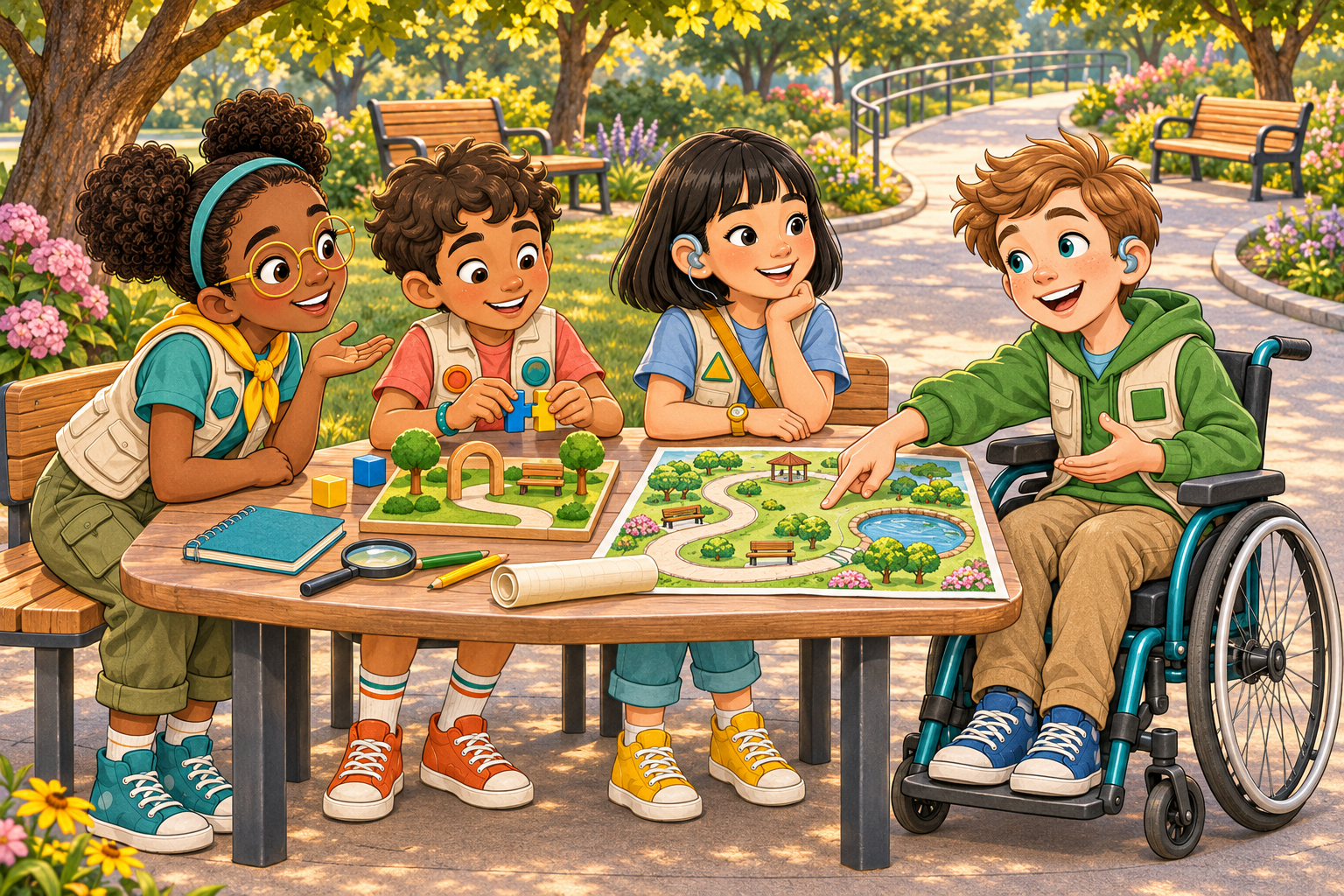
Maya with her magnifying glass and notebook
MayaThe question asker
Leo holding colorful construction pieces
LeoThe builder
Sam holding puzzle pieces
SamThe connector
Jordan in his wheelchair holding a route map
JordanThe pathfinder
Four explorers. A world of connections.
You bring the care. Start with curiosity.
Maya and the other Health Explorers meet adults sharing useful supplies outside a community center.
01 / Start with a picture, not a lecture
How to begin

You do not need
all the answers.

Open the Kids’ clubhouse with your child or class. Choose a scene about care, community, or food. Let a familiar face like Maya make a big subject feel approachable.

Ask one small question: “What do you notice?” Then leave room for their answer.

The value: a shared starting point for talking about health, without needing to deliver a formal lesson.

A friendly hello is a starting point. Social Connectedness helps us notice relationships; Community Cohesion invites us to ask how a group supports its members.

Explore the three stories ↗
Make it your own

Choose the time
you actually have.

In the Parents’ Corner, choose a 5-, 15-, or 30-minute activity. The five-minute option starts with the free coloring page and a short conversation.

At home, follow your child’s curiosity. In a group, let children speak, point, draw, or work with a partner.

Find a parent activity ↗
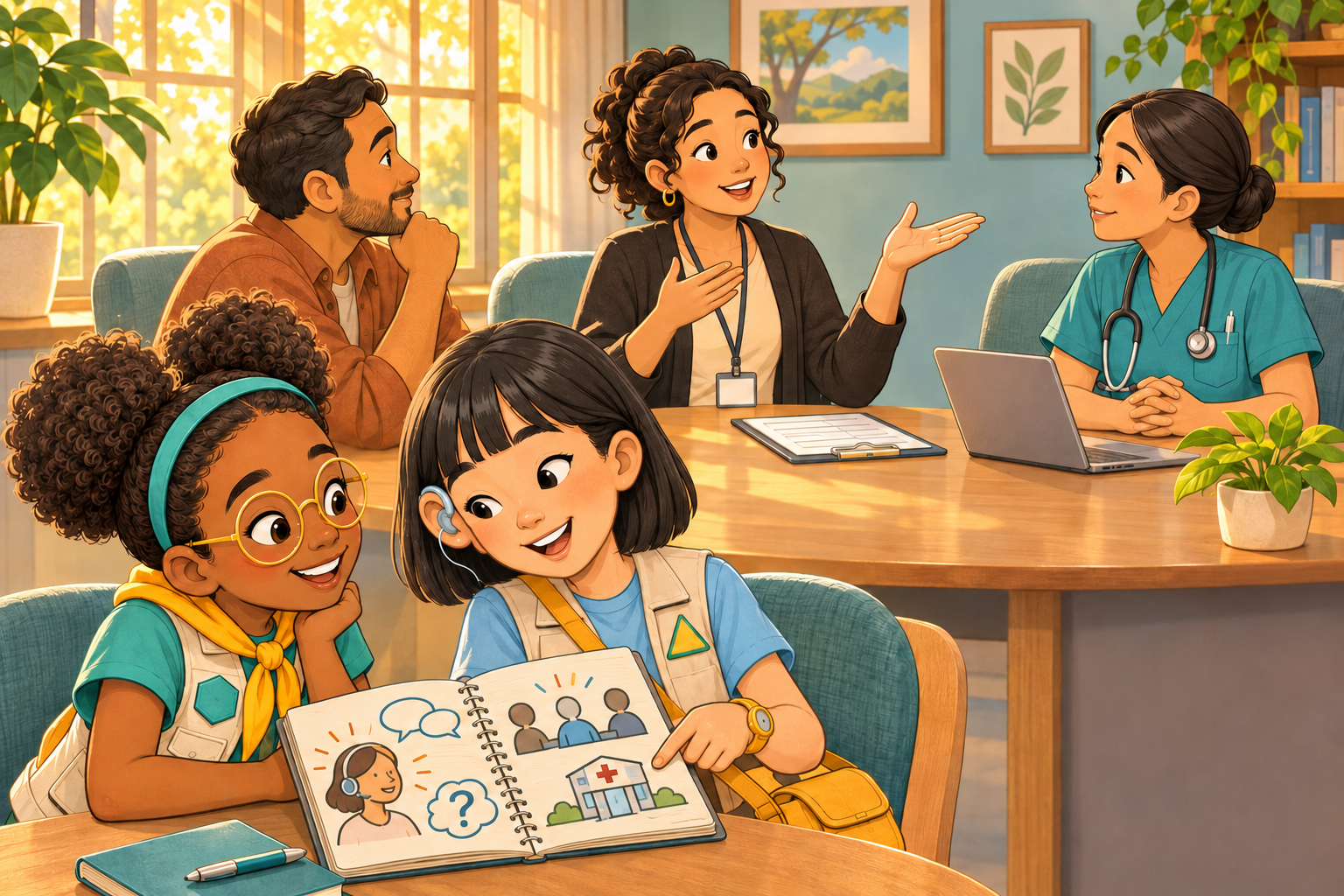
Sam and Leo speak with a welcoming health professional, illustrating an opportunity to practice asking questions.
02 / Turn curiosity into a conversation
How to begin

Help children
find their voice.

In the care story, Sam and Leo talk with a health professional. Explore the response choices together, then practice a question a child might want to ask.

Try: “Could you explain that another way?” A trusted adult can help them find the words.

The value: a low-pressure way to explore asking questions, sharing experiences, and taking part in care.

Asking a question connects Patient Engagement with Literacy & Health Communication. Adults and care teams share responsibility for making room for a child’s voice.

Try the care story ↗
Make it your own

Teachers: one scene.
A whole conversation.

The Teachers page offers a sample 15-minute conversation using the community scene. Move through Notice, Wonder, and Connect, adapting the pace to your learners.

Invite different perspectives. Use imagined examples so children do not need to share private health or family circumstances.

Walk through the sample lesson ↗
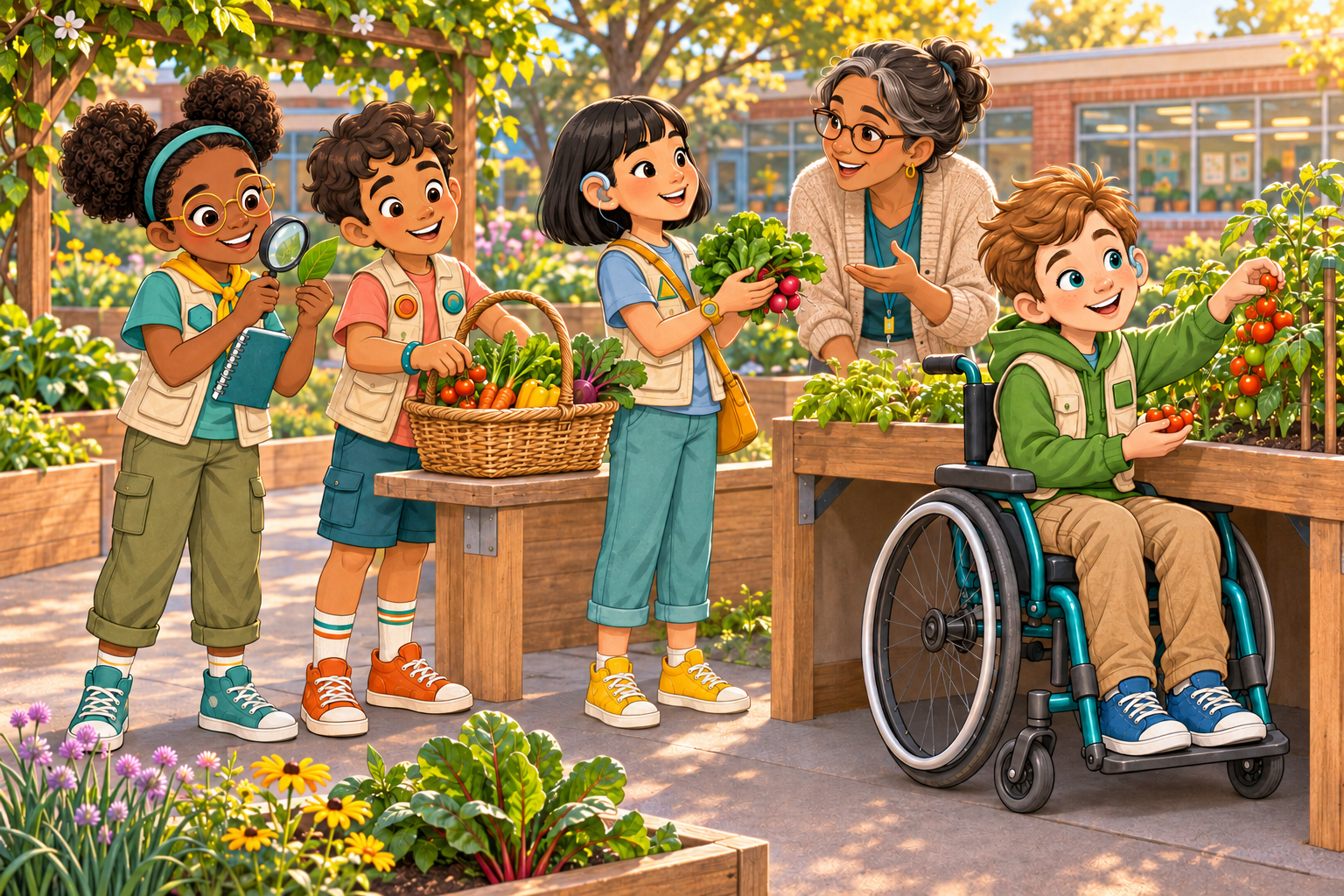
Leo and Jordan share a kitchen table with varied foods, illustrating conversations about food, belonging, and access.
03 / Connect the story to everyday life
How to begin

Make the connection
to their world.

A food scene can open a conversation about family traditions, sharing, and access. Then use the family or community health map to explore people, places, routines, resources, traditions, and one idea.

Ask: “What helps us?” It is also okay to notice a support that is missing.

The value: a broader view of health, shaped by relationships and opportunities as well as everyday choices.

Nutrition & Diet sits alongside Food Security & Hunger. A conversation about food also needs a conversation about access, not a judgment about individual choices.

Explore the health maps ↗
Make it your own

Celebrate a discovery.
Keep the door open.

Return to a question, color together, or print a discovery certificate. Celebrate noticing a connection or trying an idea, rather than finding a perfect answer.

Children do not control everything that shapes health. Parents, teachers, care teams, and communities share responsibility.

See the discovery certificate ↗
The building blocks behind the stories

Notice an element.
Explore a connection.

Ten selected elements from DHIT’s 88-element framework. Choose a tile to open a conversation prompt. These are connections to explore, not scores or instructions to fix a child.

Social ConnectednessSocioeconomic Circumstances · Element 70

Who helps us feel that we belong?

At home: Name someone you enjoy spending time with.

In a classroom: Map the people who help an imaginary child feel included.

Community CohesionSocioeconomic Circumstances · Element 81

What can people do together that is harder alone?

At home: Notice one place where neighbors help each other.

In a classroom: Plan one way to welcome a new member of the class.

PtPatient EngagementMedical Care · Element 3

How can children take part in conversations about their care?

At home: Practice a question to ask with a trusted adult.

In a classroom: Role-play a fictional visit, including time for the child’s questions.

LhLiteracy & Health CommunicationMedical Care · Element 16

What makes health information easier to understand?

At home: Try explaining an unfamiliar word in everyday language.

In a classroom: Invite words, pictures, pointing, or other communication tools.

NvNutrition & DietIndividual Behavior · Element 46

How do food, routines, and the support around us connect?

At home: Talk about a familiar meal without labeling foods or families as good or bad.

In a classroom: Explore varied food traditions using imaginary examples.

Food Security & HungerSocioeconomic Circumstances · Element 87

What helps everyone have reliable access to enough food?

At home: Notice the people and places that help food reach a table.

In a classroom: Discuss community supports, without asking children about their own household’s food access.

WiWalkabilityEnvironment · Element 28

What makes a route easier and safer to use?

At home: Notice crossings, surfaces, shade, and places to rest.

In a classroom: Design an imaginary route with different ways to move.

DaDisability Access & AccommodationsMedical Care · Element 17

What changes help a person take part?

At home: Ask about access needs rather than assuming what someone needs.

In a classroom: Discuss ramps, space, communication supports, and flexible participation.

Language BarriersSocioeconomic Circumstances · Element 77

What support helps people understand and be understood?

At home: Practice asking for language support from an adult professional.

In a classroom: Use a fictional visit to explore clear language and qualified interpreter support.

Culture/TraditionSocioeconomic Circumstances · Element 72

How can traditions connect us while leaving room for differences?

At home: Invite a story about a food, routine, or celebration, if someone wants to share.

In a classroom: Offer several examples and let children choose, imagine, or pass.

Names, symbols, and numbers follow the official table. Conversation prompts and story connections are learning activities, not official definitions or medical advice. Many elements overlap; no one controls every element.

Explore all 88 Health Elements on My World of Health ↗
Your next step / On My World of Health

Make room for
one discovery today.

You do not need to do everything. Choose where you will use it, then start with one activity.

01 / Start small

Choose your time.

Use the Parents’ Corner to select a 5-, 15-, or 30-minute activity. Let your child’s curiosity set the pace.

Choose an activity ↗
02 / Make something

Color and talk.

Use the online color studio, or download the free coloring page from the Parents’ Corner. Ask about what your child notices.

Open the color studio ↗
03 / Connect

Explore your support network.

Try a family or community health map. Name a helpful person, place, or resource, or something you wish were easier to access.

Open the health maps ↗

What is ready now: online stories, the color studio, a free printable coloring page, parent activities, health maps, a discovery certificate, and a sample teacher conversation. The classroom poster request asks for an adult email address; email updates are optional.
Still developing: the board game and wider classroom package. Full-book purchase details are marked as coming soon on the current site.

The aim is conversation, participation, and growing awareness, not a health assessment or a promise of particular health outcomes. Adapt activities to different families, bodies, ways of communicating, and access to support. Invite imagined examples instead of personal disclosures.

These imagined stories invite learning and conversation. The three additional adventures include AI-assisted illustrations and are not excerpts from the coloring and activity book. Artwork and Periodic Table of Health Elements™ belong to DHIT.